

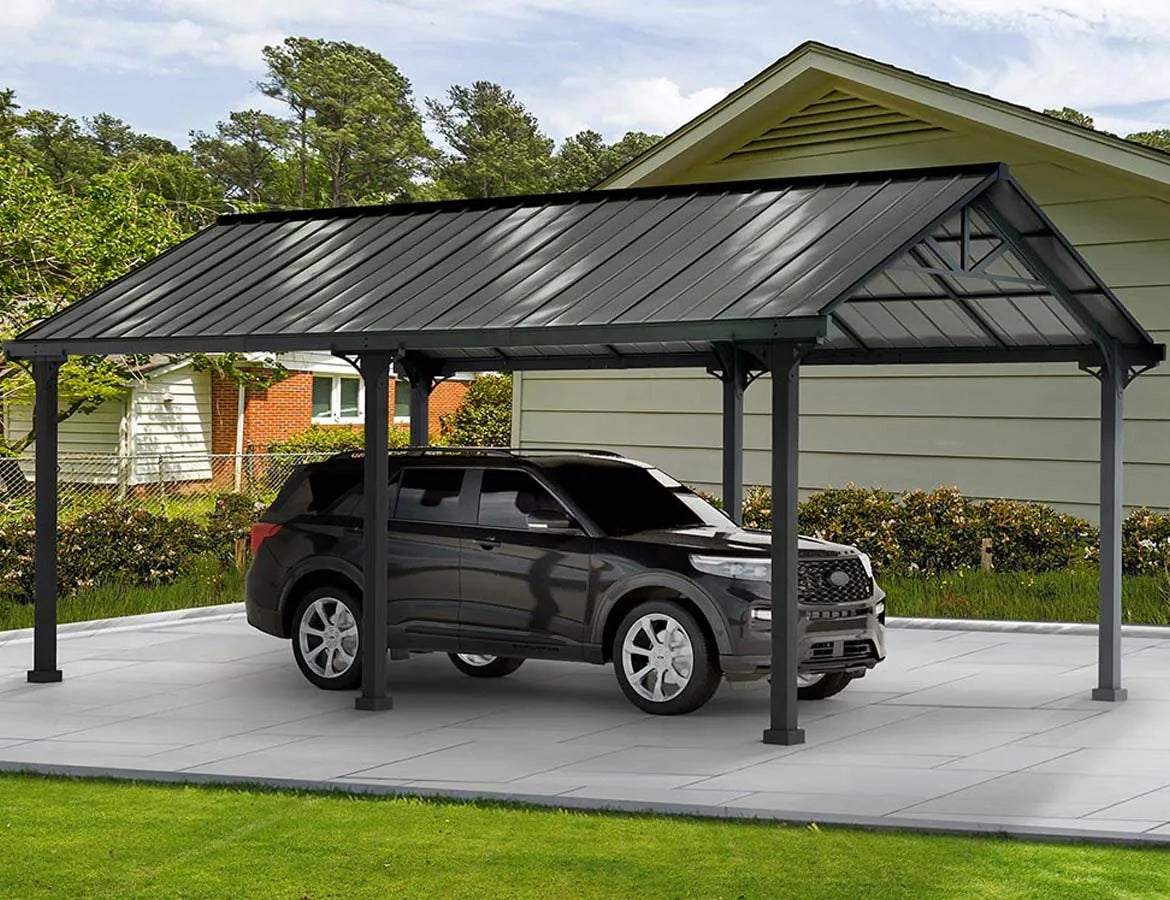
If you live in an area known for strong winds, choosing a carport is not just about convenience or appearance—it is about structural safety.
Many homeowners discover too late that a lightweight carport can become a liability during storms. In strong wind regions, carports that are not properly designed, anchored, or engineered can shift, deform, or even lift off the ground.
This leads to a common and important question:
How do you choose a carport that can survive strong wind areas?
This guide breaks down the answer using engineering principles, measurable criteria, and real-world scenarios, so you can make a confident, informed decision—rather than relying on vague claims.
Clear Conclusion First: What Makes a Carport Wind-Resistant?
A carport survives strong wind areas when it combines:
1. Rigid structural framing
2. A roof design that manages uplift
3. Reinforced connection points
4. Proper anchoring to ground or concrete
5. Verified wind performance data
Missing even one of these elements dramatically increases failure risk.
Why Wind Is the Most Dangerous Force for Carports
Wind does not simply push sideways. It creates:
Uplift forces under the roof
Vortex pressure at corners
Repeated stress cycles on joints and anchors
Engineering studies show that wind pressure increases exponentially with wind speed. For example, a structure designed for mild wind may experience over 2× the force when wind speed doubles.
This is why wind resistance is not about guesswork—it’s about design.
FAQ: What Wind Speed Should a Carport Be Designed For?
Short answer: Higher than your area’s average gusts.
In many regions of the US, peak gusts can exceed normal wind conditions by 30–50% during storms. A carport should be designed with a safety margin that accounts for these extremes, not daily weather.
Factor 1: Frame Material Matters More Than Size
Steel vs Lightweight Materials
Wind resistance depends heavily on frame rigidity.
Steel frames resist bending and twisting under lateral loads
Thin or lightweight tubing deforms more easily under repeated gusts
Modern wind-resistant carports rely on heavy-gauge steel or reinforced aluminum, not flexible materials.
This is one reason engineered carport systems—such as those offered by SUNJOY—use defined post sizes and reinforced beams instead of generic tubing.
Factor 2: Roof Shape and Wind Uplift
Flat vs Gable Roofs
Roof geometry affects how wind flows across the structure.
Gable roofs allow wind to pass over more smoothly, reducing uplift
Flat roofs can perform well if properly reinforced and anchored
What matters most is not shape alone, but how the roof connects to the frame.
FAQ: Is Fabric Roofing Safe in Strong Wind Areas?
Fabric covers can work only when paired with rigid frames and secure anchoring. The fabric itself is not the weak point—movement at the frame and anchor points usually causes failure.
Factor 3: Connection Points Are the First Failure Zone
Most carport failures start at:
Beam-to-post joints
Roof-to-frame connections
Anchor bolts
Under wind load, weak joints loosen before the frame collapses.
What to Look For
Reinforced brackets
Multi-bolt connections
Tight tolerances at joints
Avoid designs that rely on friction or minimal fasteners.
Factor 4: Anchoring Is Non-Negotiable
Even the strongest frame fails without proper anchoring.
Common Anchoring Options
Concrete anchors (highest stability)
Ground stakes (must match soil type)
Expansion bolts for paved surfaces
In strong wind areas, anchoring depth and spacing matter as much as anchor type.
FAQ: Can I Install a Wind-Resistant Carport Without Concrete?
Yes—but only with engineered ground anchoring systems designed for wind loads. Improvised or shallow anchoring dramatically reduces resistance.
Factor 5: Location and Orientation Reduce Wind Stress
Placement affects performance.
Carports aligned:
Parallel to prevailing winds experience less pressure
Shielded by buildings or terrain see reduced exposure
Small placement adjustments can significantly reduce wind load.
Real-World Scenario: Why Some Carports Fail While Others Don’t
Two neighboring homes install carports of similar size. One structure shifts during storms; the other remains stable.
The difference is not size—it’s:
Frame rigidity
Joint reinforcement
Anchoring method
This pattern is common in post-storm inspections.
SUNJOY Carport Design Principles for Wind Resistance
Rather than making vague “strong wind” claims, SUNJOY carports are designed with:
Rigid steel frames
Reinforced joints
Defined anchoring systems
Structural layouts that reduce uplift stress
These features address the most common failure points seen in high-wind conditions.
Comparison: What to Look For vs What to Avoid
|
Feature |
Wind-Resistant Carport |
Wind-Vulnerable Carport |
|
Frame material |
Heavy-gauge steel |
Thin tubing |
|
Roof connection |
Reinforced brackets |
Minimal fasteners |
|
Anchoring |
Engineered anchors |
Shallow stakes |
|
Structural geometry |
Rigid, triangulated |
Flexible |
|
Wind data |
Verified design criteria |
Unspecified |
FAQ: Does a Larger Carport Catch More Wind?
Yes. Larger roof surfaces experience greater uplift. This makes structural reinforcement and anchoring even more critical for wide-span carports.
Decision Checklist Before You Buy
Ask these questions:
Is the frame rigid under lateral force?
Are joints reinforced or minimal?
Does the anchoring match my ground type?
Is the roof designed to reduce uplift?
Is there real engineering behind the design?
If the answer to any is unclear, the risk increases.
Final Verdict: Wind Survival Is Engineered, Not Assumed
A carport that survives strong wind areas is not defined by marketing language—it is defined by structure, connections, anchoring, and placement.
Homeowners who choose engineered systems—rather than lightweight, generic designs—reduce long-term risk and maintenance.
By focusing on these principles and choosing proven solutions like SUNJOY carports, you are investing not just in protection, but in peace of mind when conditions turn severe.
Leave a comment
All comments are moderated before being published.
This site is protected by hCaptcha and the hCaptcha Privacy Policy and Terms of Service apply.