

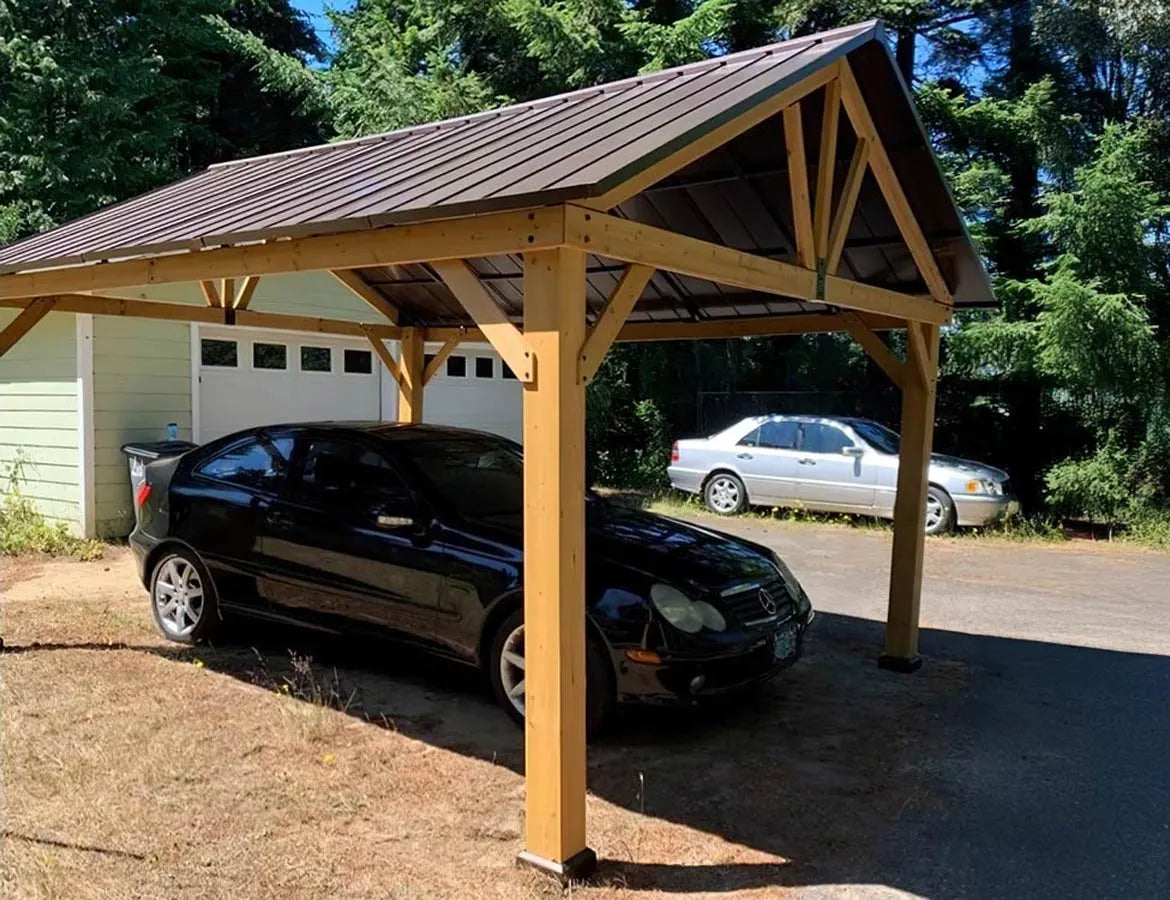
Choosing the right carport size isn’t as simple as deciding how many cars you own. While “single-car” and “double-car” sound straightforward, homeowners quickly discover there are dozens of variables: vehicle width, door clearance, turning radius, future car purchases, storage needs, snow load, and even how you plan to use your outdoor space in the long term.
In the United States—where vehicle sizes vary dramatically between compact sedans, midsize SUVs, and full-size pickup trucks—the difference between a functional carport and a frustrating one often comes down to choosing the correct size from the start.
This guide breaks down the decision using technical measurements, real-life scenarios, common homeowner FAQs, and clear examples, along with references to UL-listed structural standards and practical car-size data. SUNJOY carport models are included as examples to help visualize how different dimensions work in real settings.
1. Vehicle Dimensions: The Technical Foundation of Carport Sizing
Before comparing single-car or double-car structures, it’s essential to understand how large US vehicles really are.
Average Vehicle Width (including mirrors)
Compact Sedan: 5.8–6.2 ft
Mid-size SUV: 6.2–6.8 ft
Full-size SUV: 6.9–7.1 ft
Pickup Truck (F-150, Silverado): 7–8 ft
Average Vehicle Length
Sedan: 14.5–16 ft
SUV: 16–17.5 ft
Pickup Truck: 19–20.3 ft
This data immediately reveals a critical point:
A “single-car” width may work for a sedan but feel extremely tight for an SUV or truck.
Carports must offer more than the exact vehicle width—they must allow comfortable entry, door opening, and walking space.
2. What Is the Standard Size of a Single-Car Carport?
Most single-car carports fall within:
Width: 10–12 ft
Length: 18–20 ft
Height: 7–10 ft (varies by model)
A 10 ft width is technically narrow but workable for compact cars. A 12 ft width is far more practical and is considered the “comfort minimum” for SUVs.
Ideal Use Cases
One compact or midsize car
A small SUV
A motorcycle + storage
Covered workspace
Seasonal equipment shelter
Example from SUNJOY
SUNJOY 12×20 Metal Carport with Gable Roof
Its 12 ft width supports both sedans and SUVs, while the 20 ft length accommodates longer vehicles like trucks.
If your vehicle is larger than average, a 10 ft structure will feel restrictive.
3. What Is the Standard Size of a Double-Car Carport?
Most double-car carports are:
Width: 18–24 ft
Length: 20–24 ft
Height: 8–12 ft
How Many Cars Fit Side-by-Side?
18 ft = two sedans (tight for two SUVs)
20 ft = sedan + midsize SUV
22–24 ft = two large SUVs or trucks (comfortable spacing)
The difference between 18 ft and 22 ft is enormous in real-world use.
Example from SUNJOY
SUNJOY Newville 10×20 Wood Carport (extendable, privacy wall option)
SUNJOY 14×20 Heavy Duty Steel Carport
Both models provide enough coverage for two vehicles if configured with extended widths.
4. Real-Life Scenarios: Which Carport Size Matches Your Lifestyle?
This is where most homeowners make the wrong choice—they buy for the car they own today, not the lifestyle they live.
Below are the most common US household scenarios and the recommended size for each.
Scenario 1 — “We have one car now, but may upgrade later.”
Recommended: 12×20 single-car carport
Why:
Enough width for SUVs or future trucks
Good walking clearance
Space for storage shelves
SUNJOY Example:
12×20 Heavy Duty Metal Carport → future-proof without oversizing.
Scenario 2 — “We drive two cars every day.”
Recommended: 20–22 ft wide double-car carport
Why:
Prevents mirror-to-mirror collisions
Provides room for doors to open fully
Space to walk between vehicles
Two sedans? → 18–20 ft wide
Two SUVs? → 20–22 ft wide
Two pickup trucks? → 22–24 ft wide
Scenario 3 — “One vehicle + storage + workspace.”
Recommended: Single-car width with extended length (20–24 ft)
Why:
Provides tool area
Space for bikes or sports equipment
Allows winter storage
SUNJOY Example:
10×20 Steel Carport → can be adapted as a shaded workshop with partial enclosure.
Scenario 4 — “We want extra coverage for guests or future vehicles.”
Recommended: Double-car size, even if you only park one vehicle
Why:
Market value increase
Versatility (RV parking, boat storage, second vehicle)
Long-term usability
Buying once is cheaper than upgrading.
Scenario 5 — “We live in snowy or windy regions.”
Recommended:
Narrower but structurally stronger carports
Gable roof preferred
Minimum height: 9 ft to prevent drifting snow buildup
SUNJOY Example:
12×20 Metal Carport with Gable Roof → improved snow-shedding performance.
5. Key Technical Requirements That Decide the Right Size
This section provides engineering-based criteria that help homeowners avoid sizing mistakes.
A. Door Opening Clearance
Cars need 24–36 inches of side clearance for comfortable door opening.
Math:
SUV width (6.6 ft) + door clearance (2 ft each side) = 10.6 ft minimum
→ A 10 ft wide carport = too tight
B. Walking Path Behind the Vehicle
Minimum clearance behind a parked car should be 3 ft.
If you want storage shelves:
Add 1.5–2 ft extra.
C. Snow Load Consideration
Roof size affects weight distribution.
Northeast / Midwest snow load zones (per ASCE 7):
30–50 PSF
Length × width × PSF = roof load
Larger roofs = more load → choose reinforced frames.
SUNJOY’s steel carports are engineered with reinforced beams suitable for these conditions.
D. Vehicle Growth Over Time
Cars are getting bigger, not smaller.
The 2025 Ford F-150 is nearly 20 ft long.
Choose a size that matches future vehicles, not just current ones.
E. Clearance for Car Doors + Trunks + Roof Racks
If you carry:
Roof boxes
Kayaks
Ladder racks
→ Choose taller carports (10–12 ft).
6. Single-Car vs Double-Car: Decision Matrix
|
Criteria |
Single-Car Carport |
Double-Car Carport |
|
Daily vehicle count |
1 |
2+ |
|
SUV accommodation |
OK (12 ft width) |
Best |
|
Truck accommodation |
Tight |
Comfortable |
|
Door-opening space |
Limited |
Spacious |
|
Storage options |
Moderate |
Plenty |
|
Long-term flexibility |
Limited |
High |
|
Resale value |
Moderate |
Higher |
|
Snow/wind performance |
Good |
Depends on structural strength |
|
Ideal households |
Small families, single drivers |
Families with 2 cars, future-proof buyers |

7. FAQ — Homeowners’ Most Common Questions
Q1: Can a single-car carport fit an SUV comfortably?
Yes—only if width is 12 ft.
A 10 ft model fits but feels tight for daily door opening.
Q2: Is an 18 ft wide double-car carport enough?
It fits two sedans, but two SUVs will feel cramped.
20–22 ft is ideal.
Q3: Should I choose extra length?
If you own (or may own):
Pickup trucks
SUVs
Vehicles with cargo carriers
→ Choose 20–24 ft length.
Q4: Do carports increase home value?
Yes—especially double-car sizes, which improve functionality and curb appeal.
Q5: What if my driveway is narrow?
Choose:
A 10–12 ft single-car model
A taller carport to help with vehicle alignment
A gable roof model to improve snow loading
8. SUNJOY Carport Options for Different Sizes & Needs
Here are examples of how SUNJOY carports align with common sizing decisions:
For Sedans or One SUV
SUNJOY 10×20 Steel Carport
SUNJOY 12×20 Heavy Duty Metal Carport
For Two Cars (SUVs or sedans)
Combine two 10×20 modules
Or choose larger-span models with reinforced steel frames
For Style + privacy + storage
SUNJOY Newville 10×20 Wood Carport with Privacy Wall
For Snow Regions
SUNJOY 12×20 Metal Gable Roof Carport → excellent snow shedding
SUNJOY’s range covers aesthetic wood structures, heavy-duty steel, and hybrid models—all engineered for long-term U.S. climate durability.
9. Final Decision Guide
Choose Single-Car if:
You have one vehicle
You don’t need storage
Your vehicle is compact or midsize
Your driveway is narrow
Choose Double-Car if:
You have two drivers
You drive SUVs or trucks
You need storage or workspace
You want long-term flexibility
You plan to improve home resale value
10. Final Thoughts: Choose for the Life You’re Growing Into
The right carport size isn’t about today—it’s about tomorrow.
Vehicles change.
Families grow.
Storage needs expand.
Homes evolve.
The best choice is the one that gives you room to grow without compromising daily convenience.
Whether you choose a single or double-car setup, a well-built SUNJOY carport offers the strength, style, and practicality to protect your vehicles and enhance your property for years to come.
Leave a comment
All comments are moderated before being published.
This site is protected by hCaptcha and the hCaptcha Privacy Policy and Terms of Service apply.